
Shrink sleeve vs pressure-sensitive labels: which to choose
Two ways to decorate the same bottle can look nearly identical on the shelf and behave completely differently in tooling, on the line, and in the recycling stream. Here is how to choose between a shrink sleeve and a pressure-sensitive label without guessing.
THE SHORT ANSWER
PackOS prints pressure-sensitive roll labels, not sleeves. Pick what your container needs below. There is no universal winner. The deciding factor is your container. If it has a complex or contoured shape you want to decorate top to bottom, or you need a built-in tamper band, a shrink sleeve earns its extra tooling. If the container has a clean flat or cylindrical labeling panel and you want simpler tooling and more finish options, a pressure-sensitive label is usually the better call.
- Shrink sleeve: a printed plastic film tube shrunk with heat to hug a container 360°.
- Pressure-sensitive label: a printed face stock with adhesive applied to a defined panel.
- Sleeves win on contoured shapes, full-body coverage, and integrated tamper or multipack bands.
- Pressure-sensitive labels win on tooling simplicity and flat or cylindrical panels; recyclability depends on the label and sleeve materials.
- Cost and lead time depend on run size, colors, and finishing. Get a real quote, not a rule of thumb.
Sleeve or pressure-sensitive label?
Many containers that get sleeved could take a pressure-sensitive label instead. Pick what your container needs to see which one fits.
Sleeve or label?
What does your container need?
A wrap or front and back label
Straight or gently curved sides take a pressure-sensitive wrap or a front and back pair. White or clear BOPP with a gloss, matte or soft-touch laminate is our core build.
Squeeze BOPP
A film made to flex with squeezable PE bottles and tubes. Confirm the fit on your container with a finished-label trial.
Beverage White with CHILL adhesive
For cold, damp application and the condensation that forms as a chilled product warms. Agree the trial conditions with your filling line.
Silver or holographic BOPP
Leave ink off where you want the metal or the rainbow to show through. Finish it with a gloss, matte or soft-touch laminate.
Full 360° coverage over curves
If a tapered panel is enough, a tapered pressure-sensitive label prices instantly. Edge-to-edge coverage over compound curves is a sleeve job, and PackOS does not make sleeves.
Tamper and neck bands
Shrink tamper bands and neck bands come from a sleeve converter. PackOS does not make them. Your pressure-sensitive body label can still be priced here.
PackOS prints pressure-sensitive roll labels. It does not quote or apply shrink sleeves.
Why start in PackOS
Once you know the details, see the price, the dieline and your label on a roll in one place.
From file to price in PackOS
What you get in PackOS
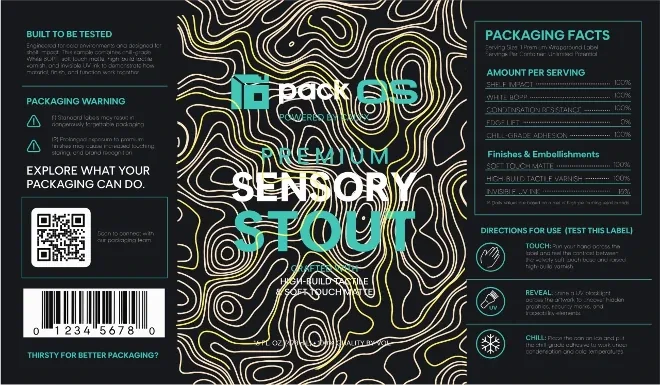
Skip the spec form
Upload a PDF or AI file and PackOS reads the size, shape, colors and finishes from your design. Nothing to retype.
Upload artwork →Instant price · sample label
| Run | Per label | Total |
|---|---|---|
| 10,000 | $0.1996 | $2,346 |
| 60,000 | $0.1692 | $10,500 |
| 110,000 | $0.1670 | $18,722 |
| 150,000 | $0.1663 | $25,290 |
| 200,000 | $0.1658 | $33,500 |
| 250,000 | $0.1655 | $41,725 |
Know the price before you ask
Every quantity is priced as soon as the file is read, with no waiting on a quote. Runs start at 10,000 labels per size with at least 2,500 per SKU. Your price depends on your artwork. Order online; the proof and a payment link follow by email.
Get instant label pricing →
Get a production dieline
No artwork yet? Draw the die with cut, bleed and safe-area lines so your designer starts from the right shape. We email it with your quote.
Create a label dieline →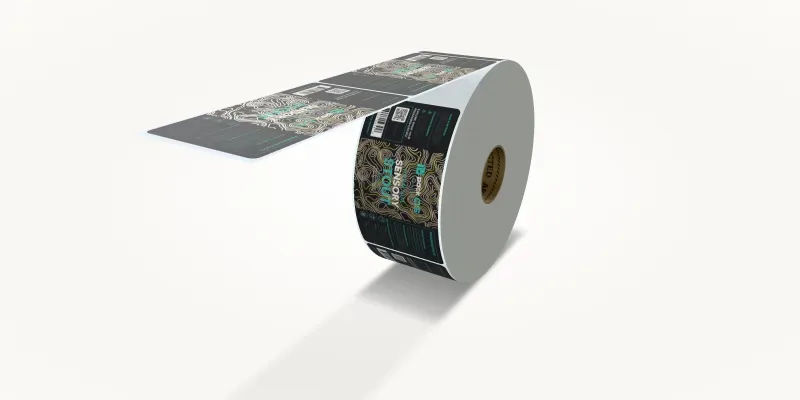
See it on the roll first
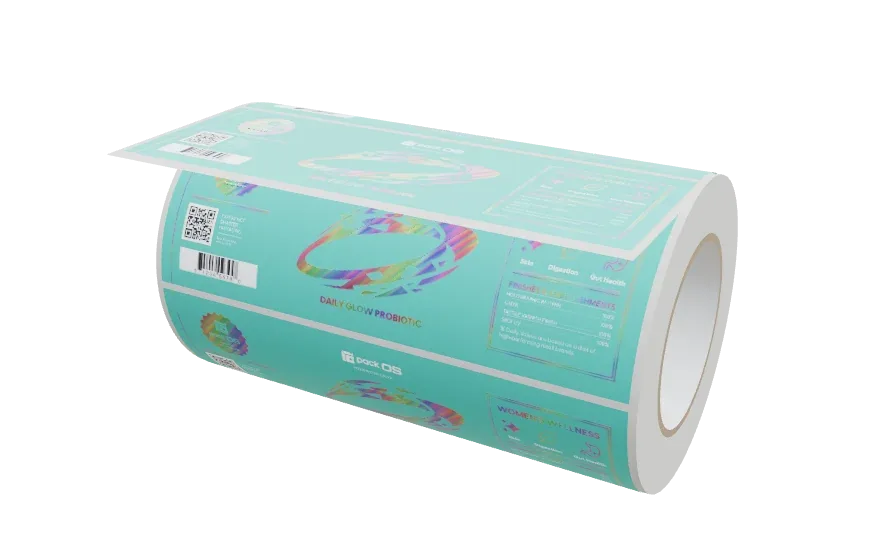
Turn your label on a 3D roll in the copy position you choose and check it before you order.
Upload artwork →Labels only. Foil, embossing and other specialty work are quoted by our team.
What each format actually is
The two formats solve the same problem (getting your brand onto a container) in fundamentally different ways. Understanding the mechanics is most of the decision. This comparison is part of our guide to choosing the right packaging, and it sits alongside the broader menu of options in label decoration methods compared.
SHRINK SLEEVE
- A tube of printed plastic film (commonly PVC, PETG, or OPS) printed on the reverse and seamed into a loop
- Slipped over the container, then passed through a heat tunnel that shrinks the film so it conforms to the container's shape, all the way around
- The graphic distorts as the film shrinks, so sleeve artwork is pre-distorted to land correctly once it hugs the body
PRESSURE-SENSITIVE (PS OR PSL)
- A three-layer sandwich: a printed face stock, an adhesive layer, and a release liner
- Die-cut on a web, then applied by hand, by a semi-automatic dispenser, or by an inline applicator to a defined panel
- Sticks where you place it and leaves the rest of the container bare
Read the full walkthrough of the shrink sleeve process in our shrink sleeve labels guide.
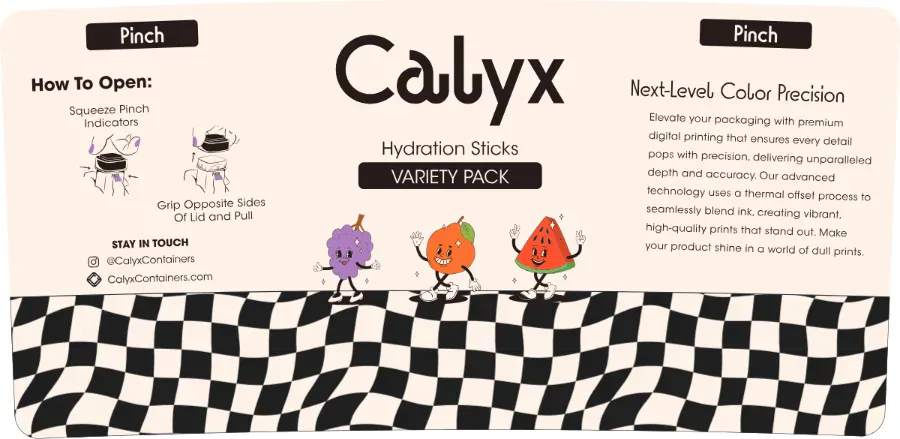
Label size calculator
Size the label from the container
Enter the diameter and panel height to get the wrap length, the label height and a dieline preview.
Open the size calculator →Shrink sleeve vs pressure-sensitive: the honest trade-off
Neither format is better across the board. Each wins in different places. The table below lays out the factors that actually drive the choice, with an honest read on both sides.
PackOS sells pressure-sensitive roll labels and does not sell or apply shrink sleeves, so we have a stake in one side of this comparison. Weigh our read accordingly. This is a genuine trade-off, not a sales pitch.
| Factor | Shrink sleeve | Pressure-sensitive |
|---|---|---|
| Coverage | 360° full-body wrap; graphics run top to bottom, including the neck, shoulder and heel | A defined panel (front, back, wrap, or spot) with the rest of the container left bare |
| Container shape | Excels on contoured, tapered, and compound-curve shapes | Best on flat panels or straight-walled cylinders; struggles on complex curves |
| Tamper evidence | Built-in perforated neck band tears visibly on opening | Optional, via destructible face stock or a separate tamper seal |
| Tooling & minimum run | Adds a seaming step and a shrink step; sleeve format tooling on top of print | Simpler die tooling; digital print suits short runs and many SKUs |
| Decoration & finishes | Seamless billboard look; finish range limited by the shrink film | Wide face-stock, texture, and finish menu: foils, textured papers, specialty coatings |
| Recyclability | Can complicate container recycling unless the sleeve washes off, floats, or matches the container resin | Smaller footprint, but face stock and adhesive still affect the container's recyclability |
| Application | Placed over the container, then heat-shrunk in a tunnel | Applied by hand, semi-auto, or inline applicator to the panel |
Read the table as a set of dials, not a scoreboard. The right answer is the format that matches the most rows that matter to your product.
Want to talk it through with someone? Book an enterprise demo.
Book an enterprise demo →Where shrink sleeves genuinely win
Sleeves shine when the container itself is the reason you can't use a flat label. Their strengths cluster around shape and coverage:
- Contoured and compound-curve containers. Waisted bottles, tapered tubs, and odd silhouettes that a flat label would wrinkle or flag on are exactly where a sleeve conforms cleanly.
- Full-body billboards. When you want an unbroken, edge-to-edge graphic that reads as one continuous surface, with no visible label boundary, a sleeve delivers a look a panel label can't.
- Integrated tamper evidence. A perforated neck band that tears on first open gives obvious, built-in tamper evidence without a second component.
- Multipack and promotional banding. Sleeves can gang multiple units together or add a temporary promotional wrap over an existing decoration.
- Decorating over seams and features. Because the film shrinks to the surface, it can carry graphics across handles, indents, and steps that would defeat a flat label.
The cost of those wins is complexity: a sleeve adds a seaming operation and a heat-shrink application step, the artwork has to be distorted to survive the shrink, and, as the next section covers, the material choice has real recyclability consequences.
Have your artwork? See the price for every quantity in seconds.
Get instant label pricing →Where pressure-sensitive labels genuinely win
Pressure-sensitive labels win on simplicity, flexibility, and material choice. If your container has a clean labeling panel, a PS label is usually the lower-friction path:
- Simpler tooling and setup. A PS label needs a cut die and print (no seaming, no shrink tunnel), which keeps the front of the job simpler and makes short runs and frequent artwork changes far easier.
- A deeper finish menu. Face-stock choice is enormous: coated and uncoated papers, films, textured and specialty stocks, foils, and tactile coatings that a shrink film can't match.
- Variable data and versioning. Digital PS printing makes many SKUs, seasonal versions, and serialized or variable data straightforward, without new format tooling for every change.
- Front-and-back or spot decoration. When you only need a defined area labeled (leaving clear windows to show product, or a bare base), a panel label is the natural fit.
- Easier recovery in recycling. A smaller label that peels or floats away tends to interfere less with container recycling than a full-body sleeve, though the details still matter.
Where PS labels give ground is coverage and shape. They can't wrap a compound curve seamlessly, and getting a true 360° look means a wrap label with a visible seam or overlap rather than the continuous body of a sleeve.
If your container has a clean labeling panel, price the pressure-sensitive option from your artwork.
Upload artwork for an instant quote →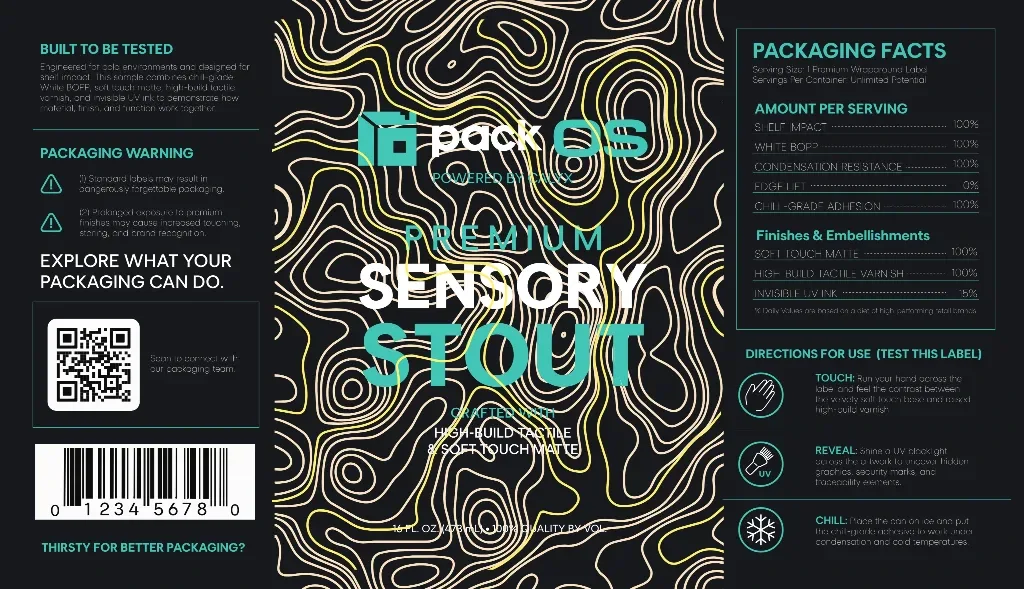
Finish picker
Compare gloss, matte and soft touch
See the same label under each laminate, then upload your artwork for an instant price.
Compare the finishes →The recyclability caveat
This is the factor most comparisons gloss over, so it's worth stating plainly. A full-body shrink sleeve can interfere with how a container is recycled. Material recovery facilities lean on optical sorters that read the surface they see, and on a fully sleeved container, that surface is the sleeve, not the bottle. If the sleeve resin differs from the container resin and covers most of the body, the container can be mis-sorted or downgraded unless the sleeve is designed to separate.
The mitigations are real but have to be chosen deliberately:
- Wash-off sleevesRelease from the container in the recycling wash.
- Float-separable filmsTheir density lets them part from the container in a sink-float step.
- Matched resinThe sleeve resin matches the container, so the whole item stays in one stream.
Which approach applies depends on the container, the sleeve film, and the recycling system it lands in, so treat this as a design decision, not an afterthought.
Pressure-sensitive labels are not automatically clean, either. A small label usually has a smaller footprint, but the face stock, the adhesive, and whether the label releases in the wash all affect the outcome. In both cases the honest move is to design for recyclability up front and check the current guidance rather than assume. Our sustainable packaging guide covers the broader picture, and the Association of Plastic Recyclers publishes design guidance for exactly these decisions.
No artwork yet? Draw a production dieline with cut, bleed and safe-area lines.
Create a label dieline →How to decide
You can usually settle the question by walking the same short sequence in order. The first factor that clearly points one way is often the answer:
- Look at the containerComplex curve or full-body graphic ambition → lean sleeve. Clean flat or cylindrical panel → lean pressure-sensitive.
- Decide the coverageDo you need true 360°, edge-to-edge decoration, or is a defined panel enough?
- Check tamper needsIf you want obvious, built-in tamper evidence, a sleeve neck band is the simplest route, but a destructible PS label or a separate seal can also do the job.
- Weigh run size and SKU countMany versions, short runs, and frequent changes favor the simpler tooling of pressure-sensitive; long, stable runs soften the added setup of a sleeve.
- Factor in recyclability goalsIf a clean single-material recycling story matters, weigh the sleeve's separation strategy against a smaller label footprint.
- Then quote bothOnce the shape and coverage narrow it down, the cost and lead-time comparison depends on your real quantity, colors, and finishing, so compare actual quotes rather than guessing at a break-even.
If you want a fast first pass, the label format picker walks you through these same questions and points to the format that fits your container and coverage.
Instant label pricing
Upload your artwork and see the price
Drop in a PDF or AI file. PackOS reads the size, shape and colors and prices it from 10,000 labels per size.
Upload artwork →Pricing the pressure-sensitive option
Because PackOS sells pressure-sensitive roll labels and does not sell or apply shrink sleeves, the pressure-sensitive side of this comparison is the one you can price with us. Ask a sleeve converter for a sleeve quote on your container, quantity and finishing, then upload your label artwork to Quick Quote, review the detected attributes and confirm the selected specification. Compare the two on your own job, not a generic table: when cost is the deciding factor, real numbers for both formats beat any rule of thumb. Quick Quote prices our film stocks with laminates, varnishes, spot UV and tactile finishes, from 10,000 labels per label size with at least 2,500 per SKU. Foil, embossing and textured papers are quoted by our team.
Frequently asked questions
What's the difference between a shrink sleeve and a pressure-sensitive label?
A shrink sleeve is a printed plastic film tube that is placed over a container and shrunk with heat so it hugs the full shape, wrapping the container all the way around. A pressure-sensitive label is a printed face stock with an adhesive backing that is applied to a flat or cylindrical panel. The sleeve decorates the whole body and follows contours; the label sticks to a defined area.
Are shrink sleeves harder to recycle than pressure-sensitive labels?
Often, yes, though it depends on the materials. A full-body sleeve made from a different plastic than the container can confuse optical sorters and interfere with recycling unless it is designed to wash off or float away. A pressure-sensitive label usually covers less area, but its face stock and adhesive still matter. Check current recyclability design guidance from the Association of Plastic Recyclers for your specific structure.
When is a shrink sleeve worth the extra tooling?
A shrink sleeve earns its extra setup when the container has a complex or contoured shape you want to decorate from top to bottom, when you want a seamless full-body look, or when you need an integrated tamper-evident neck band or a multipack band. If the container has a clean flat or cylindrical labeling panel and you do not need full coverage, a pressure-sensitive label is usually simpler.
Can you get tamper evidence without a shrink sleeve?
Yes. Shrink sleeves make tamper evidence easy because a perforated neck band tears when opened, but pressure-sensitive labels can also provide tamper evidence through breakaway or destructible face stocks and tamper-evident seals. The right choice depends on your container, your regulatory needs, and how obvious you want the tamper feature to be.
Do shrink sleeves cost more than pressure-sensitive labels?
It depends on run size, number of colors, coverage, and finishing, so there is no fixed answer. Sleeves add a seaming step and a heat-shrink application step, and full-body coverage uses more printed material, which can raise cost. Pressure-sensitive tooling is usually simpler. The only reliable way to compare is to quote both against your real container, quantity, and artwork.