
Label Materials: Paper, BOPP, PE & PET
A material name starts the conversation; it does not finish the specification. Compare the face stock, then connect the exact grade, adhesive, liner, printing and finish to your container and application conditions.
THE SHORT ANSWER
Pick the material by where the label will live, then price it. BOPP means biaxially oriented polypropylene: a film face stock, not a complete label specification. Paper, BOPP, PE, PET and vinyl are candidate material families. Choose a specific construction using the required appearance, container surface, application process and service conditions, then qualify the finished label before releasing production.
Pick a material by where the label will live
Start with the conditions, not the material name. Our core is general-purpose acrylic adhesive labels on BOPP film: white, clear, silver or holographic, finished with a gloss, matte or soft-touch laminate. For utility labels, ask us about thermal transfer and direct thermal paper stocks.
Material picker
Where will your label live?
White BOPP, general-purpose acrylic adhesive
Conditions it suits
- Dry glass, rigid plastic or carton
- Room temperature, indoors
- Opaque white film under the print
- Gloss, matte or soft-touch laminate over the print
Clear BOPP, general-purpose acrylic adhesive
Conditions it suits
- A no-label look on glass or clear plastic
- The container or product shows behind the design
- White ink under any print that needs to read
- Gloss, matte or soft-touch laminate over the print
Silver BOPP, general-purpose acrylic adhesive
Conditions it suits
- A metallic silver film behind the ink
- Dry glass, rigid plastic or carton
- Film left unprinted where the silver should show
- Gloss, matte or soft-touch laminate over the print
Holographic BOPP, general-purpose acrylic adhesive
Conditions it suits
- A rainbow holographic film behind the ink
- Dry glass, rigid plastic or carton
- Film left unprinted where the hologram should show
- Gloss, matte or soft-touch laminate over the print
Squeeze BOPP
Conditions it suits
- Flexible PE bottle or tube
- Squeezed and flexed every use
- Wet hands in the kitchen or bathroom
- Room temperature
Beverage White with CHILL adhesive
Conditions it suits
- Applied cold or damp on the filling line
- Chilled storage, coolers and ice buckets
- Condensation as the product warms
- Glass or aluminum
Thermal transfer and direct thermal paper
Conditions it suits
- Utility labels printed on demand
- Barcodes, shipping, warehouse and date or lot codes
- Direct thermal for short-term use, thermal transfer for longer life
- Direct thermal kept away from heat and light
Specialty adhesives and paper stocks
Conditions it suits
- Freezer, outdoor, removable or wash-off requirements
- Wine, spirits and craft products on coated or textured paper
- A paper feel and texture in the hand
- Tell us the container and the conditions
Not sure which one? Tell our team the container and the conditions and we will point you to the right construction. Confirm it with a finished-label trial.
Why start in PackOS
Once you know the stock, see the price, the dieline and your label on a roll in one place.
From file to price in PackOS
What you get in PackOS
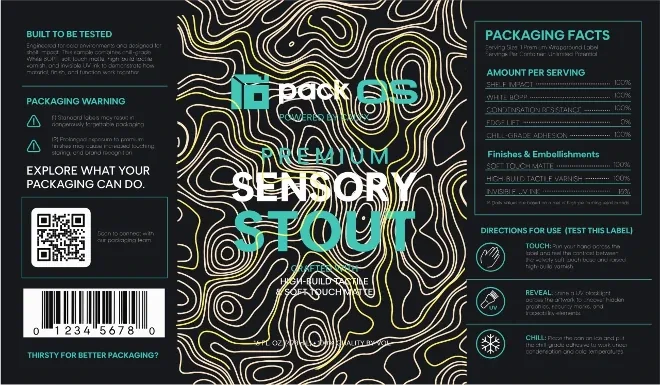
Skip the spec form
Upload a PDF or AI file and PackOS reads the size, shape, colors and finishes from your design. Nothing to retype.
Upload artwork →Instant price · sample label
| Run | Per label | Total |
|---|---|---|
| 10,000 | $0.1996 | $2,346 |
| 60,000 | $0.1692 | $10,500 |
| 110,000 | $0.1670 | $18,722 |
| 150,000 | $0.1663 | $25,290 |
| 200,000 | $0.1658 | $33,500 |
| 250,000 | $0.1655 | $41,725 |
Know the price before you ask
Every quantity is priced as soon as the file is read, with no waiting on a quote. Runs start at 10,000 labels per size with at least 2,500 per SKU. Your price depends on your artwork. Order online; the proof and a payment link follow by email.
Get instant label pricing →
Get a production dieline
No artwork yet? Draw the die with cut, bleed and safe-area lines so your designer starts from the right shape. We email it with your quote.
Create a label dieline →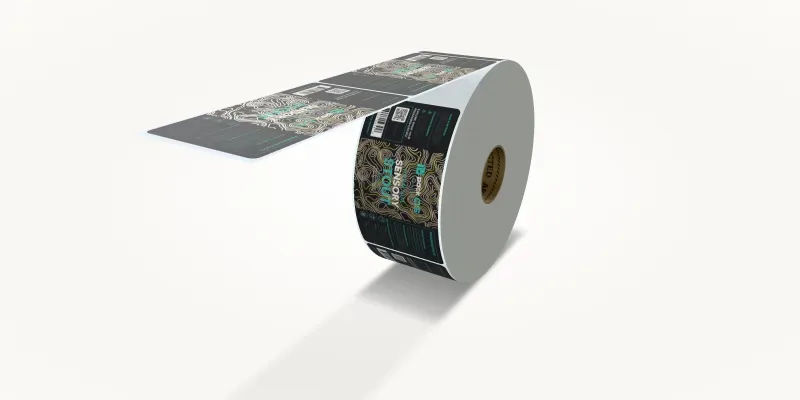
See it on the roll first
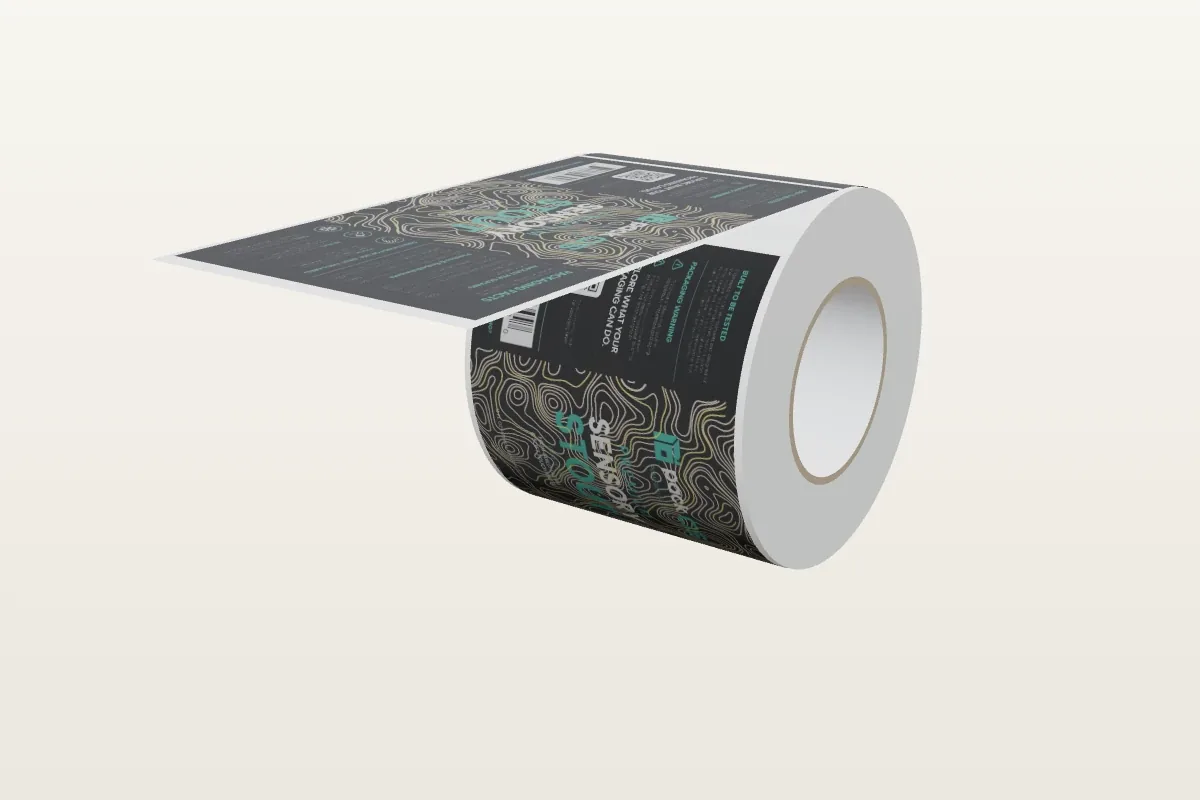
Turn your label on a 3D roll in the copy position you choose and check it before you order.
Upload artwork →Labels only. Foil, embossing and other specialty work are quoted by our team.
Specify the complete construction
- Face stockCarries the printed image.
- Pressure-sensitive adhesiveAttaches the face stock to the container.
- Release-coated linerCarries the label through converting and dispensing.
Printing, coatings and laminates add requirements beyond those three layers.
Ask the supplier for a construction reference that identifies the actual combination being offered. Do not assume that choosing each component by name creates an available or qualified product. For the approval record, use the pressure-sensitive label construction guide; for the wider buying process, see the label printing guide.
Compare paper, BOPP, PE, PET and vinyl
Use this table to frame a supplier discussion. It is not a performance ranking, price list or list of every material offered in the packOS quote flow.
| Candidate | Reason to consider it | Resolve before approval |
|---|---|---|
| Coated, uncoated or textured paper | A paper surface or tactile appearance is part of the brief. | Exact grade, print treatment and required moisture exposure; ask about wet-strength options when relevant. |
| White BOPP | A white film face is the intended appearance. | Opacity, color target, surface treatment and the complete construction. |
| Clear BOPP | The design uses the visible container or product. | White-ink plan, clarity, adhesive appearance and a sample on the filled container. |
| Metallized BOPP | The design includes reflective areas. | Metallic versus opaque artwork regions, color appearance and finish. |
| Holographic BOPP | The design uses a rainbow, reflective film look. | Where the film shows through the print, color appearance and finish. |
| PE (polyethylene) | The container squeezes or flexes in use. | Actual deformation, label geometry and printed-sample behavior. |
| PET (polyester) | The brief calls for a durable-label construction. | Specific chemical, temperature or abrasion requirements and evidence for the proposed grade. |
| Vinyl (PVC) | A supplier proposes a vinyl construction for the application. | Exact grade, flex and exposure evidence, plus any customer material restrictions. |
| Thermal transfer and direct thermal paper | Utility labels printed on demand, such as barcodes, shipping and date codes. | Printer type, ribbon for thermal transfer, expected service life and storage away from heat and light. |
UPM lists PP, PE and PET film portfolios, including PE options for squeezable containers. Its paper portfolio includes coated, uncoated and wet-strength grades. These categories help form a shortlist; they do not certify a particular printed label. UPM film materials · UPM paper materials
Compare cost only after aligning dimensions, quantity, construction and finishing requirements. A cheaper price for a different construction is a different proposal. Use the label cost and quote comparison guide to separate first-release and reorder charges.
Have your artwork? See the price for every quantity in seconds.
Get instant label pricing →What is BOPP label material?
BOPP stands for biaxially oriented polypropylene: polypropylene film stretched in two directions during manufacture. In a pressure-sensitive label specification it identifies the face-stock family, not the adhesive or the complete printed product. Avery’s BOPP explanation
“White BOPP” is still incomplete as a purchase specification. Two quotes can share that name while using different grades, thicknesses, print treatments, adhesives, liners or finishes. Request the construction code and relevant technical data, then record the approved artwork and finish alongside it.
White: agree the expected opacity and color appearance on the container. Clear: identify white-ink areas and intentionally transparent areas; review them against the actual product and container. Metallized: distinguish areas intended to show the reflective face from areas intended to be opaque. Ask the printer how the artwork separations will produce that result.
A screen preview helps check layout but does not reproduce the physical substrate, adhesive clarity or reflective effect. Review a representative printed sample when those properties determine approval. See the label artwork setup guide for file preparation.
Adhesive: application and service are separate
Describe the actual surface: container supplier item, material, coating, geometry, cleanliness and moisture state. Record surface temperature at application separately from later storage and use. A label applied before chilling faces a different sequence from one applied to an already cold or wet container.
Permanent, removable, freezer and all-temperature are useful supplier categories, not interchangeable guarantees. For removable labels, specify the intended removal time and acceptable residue or surface change. For cold use, ask whether the exact construction supports the proposed application condition as well as the later service condition. Do not assume that frost or condensation is acceptable.
Request application guidance and an agreed conditioning interval before testing. Record deviations from the proposed production process. For beverage exposure planning, use the bottle-to-cooler label guide.
Labeling bottles that go from the filling line to the cooler? See the food and beverage label page.
See food & beverage labels →Liner: include the dispensing process
The liner is removed during application, but it remains part of the ordered construction. Record the exact paper or film liner, thickness and roll format. Ask the converter and applicator operator to confirm release, feeding and sensor requirements for the proposed combination.
Glassine versus PET is not a reliable shortcut for predicting jams or throughput. Run representative converted rolls on the intended equipment. For hand application, check whether operators can dispense and place the label reliably. Keep the unwind direction, core and roll outside-diameter requirements with the job.
Read the data sheet before comparing materials
| Field to request | Decision it supports | Question if missing |
|---|---|---|
| Construction and component references | Whether quotes and samples describe the same product | Which exact face, adhesive and liner are included? |
| Face-stock thickness and print treatment | Fit with the print and converting process | Is this grade supported for the proposed press and ink system? |
| Application conditions | Whether the label can be attached as intended | What surface and temperature conditions are supported? |
| Service conditions | Whether later use is covered by the evidence | Does the evidence represent our exposure sequence? |
| Test method and conditions | Whether a reported value answers the actual requirement | What substrate, conditioning and acceptance criteria were used? |
| Revision and supplier confirmation | Whether the information applies to the offered construction | Is this the current data for this market and supply source? |
A reported material value and a finished-label trial answer different questions. Ask the supplier to explain which evidence supports the proposed use and what still needs testing. Retain the data-sheet revision with the sample and approval record.
Five exposures to define before the trial
Agree the sample count, conditioning, exposure sequence, observation intervals and acceptance criteria before testing. Select only conditions that represent the actual product, distribution and use. The following are planning questions, not universal test protocols.
- WaterIs the exposure a splash, condensation, wet handling or immersion? Define temperature and duration.
- Oil or product contactIdentify the actual substance and how it contacts the face, edge or adhesive.
- Cold and thawingSeparate application, freezing, storage and return to warmer air.
- Squeeze or flexUse the intended filled container and define the deformation and repetitions.
- Outdoor or cleaning exposureIdentify the expected light, weather or cleaning sequence and the evidence required.
Record attachment, appearance, legibility and dispensing behavior separately. A label may stay attached while its graphics fail the appearance requirement. Photograph the sample, identify deviations and retain the exact tested construction.
Labeling supplements? Start with the supplement label page.
Supplement labels →Keep environmental requirements specific
Define the outcome you need, request evidence for that requirement and the exact materials being supplied, and assess the decorated container as a whole.
A SPECIFIC REQUIREMENT
- Documented recycled content
- A relevant sourcing claim
- Compatibility with a named container recycling system
- A liner collection route, kept separate from the consumer package
NOT PROOF BY ITSELF
- A paper face, which does not by itself prove recyclability
- A film name, which does not establish incompatibility or a comparative environmental advantage
If the construction changes, ask whether the earlier evidence still applies.
Match the material to printing and finishing
Confirm that the proposed grade and print surface suit the printer’s actual process. Include the ink system, white-ink requirement, varnish or laminate, and any later variable-data printing. A material-family name does not establish compatibility with every digital or conventional press.
Finish picker
The same label in gloss, matte and soft touch
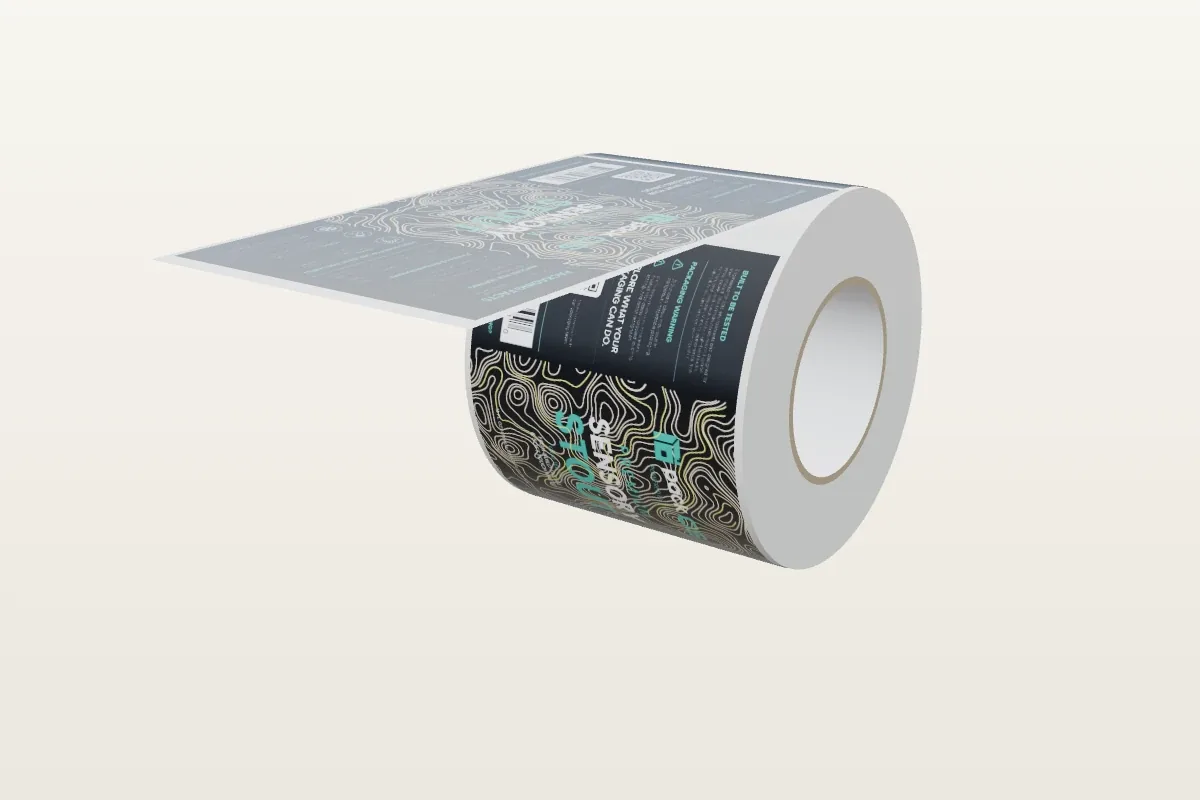
Gloss laminate
A clear, shiny film over the print. Colors look deeper and the surface reflects light, so highlights run across the label as it turns. Fingerprints and scuffs show more than on matte.
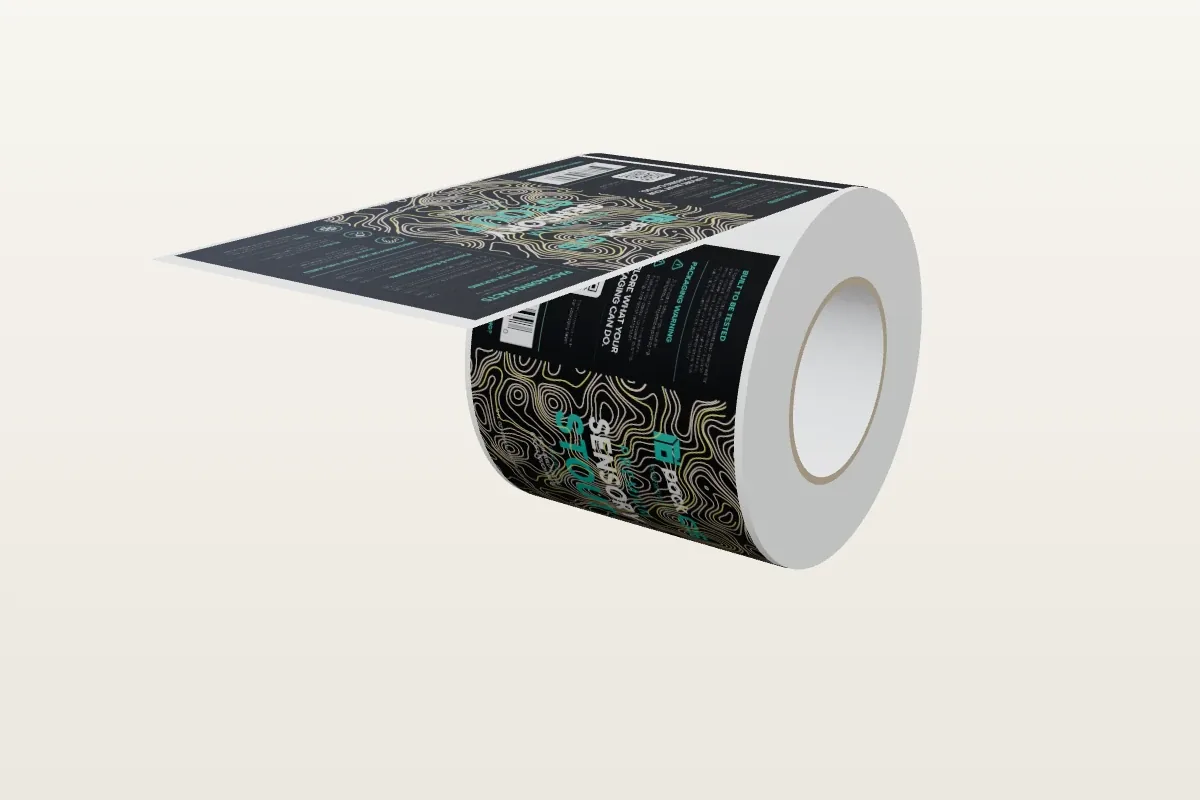
Matte laminate
A flat, non-reflective film. Softer color and no glare under shelf lighting. Often chosen for a premium, understated look.
Soft-touch laminate
A velvet matte film with a suede feel in the hand. Muted and soft to the eye, and the finish people pick up to touch.
All three are priced instantly, as are spot UV and raised tactile varnish. Foil, embossing and debossing are quoted by our team.
Ask for a representative sample of the proposed finish. Gloss, matte and tactile finishes change the appearance brief; they should not be treated as automatic protection against every exposure. Review color, legibility and handling on the finished construction before approving the revision.
Qualify and control the approved construction
Use one record to connect:
- The container
- Construction code
- Artwork revision
- Print and finish
- Trial conditions and results
- Approval owner
Mark untested options as proposed. Keep restrictions and open questions visible until the responsible team resolves them.
Download the construction trial worksheet (CSV)
Use the worksheet instructions to plan the record. This blank resource does not certify a material or approve an order, and downloading it does not send completed supplier records to packOS.
For multi-SKU programs, identify which products share a qualified construction and which differ in container, use or finish. A shared artwork template is not evidence of equivalent physical performance. Review substitutions and changed conditions before releasing a reorder.
Instant label pricing
Upload your artwork and see the price
Drop in a PDF or AI file. PackOS reads the size, shape and colors and prices it from 10,000 labels per size.
Upload artwork →Bring the material requirements into a label quote
Start with the label artwork, dimensions and quantity by SKU. Review detected attributes and the available material and finish choices, then confirm the intended specification. Keep the container and application requirements with the request; artwork alone cannot establish them.
packOS currently quotes custom roll labels. The material families discussed here are buying context, not a promise that every grade is selectable or available. Confirm any requirement outside the quote options with the team. Use the custom roll-label buying page for specification and order preparation.
Frequently asked questions
What is BOPP label material?
BOPP is biaxially oriented polypropylene, a film stretched in two directions during manufacture. In a pressure-sensitive label, it describes the face stock. Adhesive, liner, printing and finish still need to be specified; the name alone does not establish performance on your container.
What is the difference between white and clear BOPP labels?
White BOPP provides a white face, while clear BOPP lets the underlying container and product influence the appearance. For clear labels, identify where white ink is required and review a representative printed sample on the filled container. Confirm opacity and color expectations with the printer for either option.
Are BOPP labels waterproof?
A BOPP face stock does not prove that the finished label will meet a waterproof requirement. Describe the water exposure, temperature, duration and handling, then agree acceptance criteria for adhesion, appearance and legibility. Qualify the actual adhesive, print and finish on the intended container.
Can paper labels be used on chilled products?
Some paper portfolios include wet-strength grades intended for moisture exposure. That does not qualify every paper label for chilled service. Ask for an appropriate construction and assess the printed and finished sample through the actual application and storage sequence.
How do BOPP, PE, PET and vinyl labels differ?
They are different film families with multiple grades. Use the container geometry, required flex, appearance and exposure to shortlist candidates with the supplier. PE may be considered for squeeze applications and PET for durable-label requirements, but neither designation replaces testing the complete construction.
What label material should I choose for freezer use?
Separate conditions during application from conditions after the label is attached. Provide the container surface, temperature and moisture state, plus the freezing and thawing sequence. Request a supplier-supported construction and trial it under the agreed conditions rather than relying on the word freezer.
Does the liner matter for label application?
Yes. Record the liner type and thickness along with the roll format and dispensing equipment. Review release, feeding, sensor compatibility and handling with the converter and applicator operator. A glassine or PET name alone does not establish line performance, and hand application still needs a usable release.
Can the label be recycled with the container?
That depends on the complete decorated package and the intended recycling system. Request evidence covering the actual container, face stock, adhesive and finish in the relevant market. Treat liner collection as a separate question; neither a paper nor film label name proves a recycling outcome.