
Why Labels Won’t Stick: Diagnose Adhesion Failures
A lifting label is an observation, not a diagnosis. Preserve the evidence, describe when the failure appears and compare the actual construction and process before changing the specification.
THE SHORT ANSWER
Pick the material by where the label will live, then price it. Labels may fail because the construction and surface are incompatible, application conditions differ from the approved process, or the finished label encounters an unqualified exposure. Start with the failed unit, label and container lot references, and a timeline. A symptom alone cannot identify the cause or assign responsibility.
Pick a material by where the label will live
Start with the conditions, not the material name. Our core is general-purpose acrylic adhesive labels on BOPP film: white, clear, silver or holographic, finished with a gloss, matte or soft-touch laminate. For utility labels, ask us about thermal transfer and direct thermal paper stocks.
Material picker
Where will your label live?
White BOPP, general-purpose acrylic adhesive
Conditions it suits
- Dry glass, rigid plastic or carton
- Room temperature, indoors
- Opaque white film under the print
- Gloss, matte or soft-touch laminate over the print
Clear BOPP, general-purpose acrylic adhesive
Conditions it suits
- A no-label look on glass or clear plastic
- The container or product shows behind the design
- White ink under any print that needs to read
- Gloss, matte or soft-touch laminate over the print
Silver BOPP, general-purpose acrylic adhesive
Conditions it suits
- A metallic silver film behind the ink
- Dry glass, rigid plastic or carton
- Film left unprinted where the silver should show
- Gloss, matte or soft-touch laminate over the print
Holographic BOPP, general-purpose acrylic adhesive
Conditions it suits
- A rainbow holographic film behind the ink
- Dry glass, rigid plastic or carton
- Film left unprinted where the hologram should show
- Gloss, matte or soft-touch laminate over the print
Squeeze BOPP
Conditions it suits
- Flexible PE bottle or tube
- Squeezed and flexed every use
- Wet hands in the kitchen or bathroom
- Room temperature
Beverage White with CHILL adhesive
Conditions it suits
- Applied cold or damp on the filling line
- Chilled storage, coolers and ice buckets
- Condensation as the product warms
- Glass or aluminum
Thermal transfer and direct thermal paper
Conditions it suits
- Utility labels printed on demand
- Barcodes, shipping, warehouse and date or lot codes
- Direct thermal for short-term use, thermal transfer for longer life
- Direct thermal kept away from heat and light
Specialty adhesives and paper stocks
Conditions it suits
- Freezer, outdoor, removable or wash-off requirements
- Wine, spirits and craft products on coated or textured paper
- A paper feel and texture in the hand
- Tell us the container and the conditions
Not sure which one? Tell our team the container and the conditions and we will point you to the right construction. Confirm it with a finished-label trial.
Why start in PackOS
Once you know the details, see the price, the dieline and your label on a roll in one place.
From file to price in PackOS
What you get in PackOS
Skip the spec form
Upload a PDF or AI file and PackOS reads the size, shape, colors and finishes from your design. Nothing to retype.
Upload artwork →Instant price · sample label
| Run | Per label | Total |
|---|---|---|
| 10,000 | $0.1996 | $2,346 |
| 60,000 | $0.1692 | $10,500 |
| 110,000 | $0.1670 | $18,722 |
| 150,000 | $0.1663 | $25,290 |
| 200,000 | $0.1658 | $33,500 |
| 250,000 | $0.1655 | $41,725 |
Know the price before you ask
Every quantity is priced as soon as the file is read, with no waiting on a quote. Runs start at 10,000 labels per size with at least 2,500 per SKU. Your price depends on your artwork. Order online; the proof and a payment link follow by email.
Get instant label pricing →
Get a production dieline
No artwork yet? Draw the die with cut, bleed and safe-area lines so your designer starts from the right shape. We email it with your quote.
Create a label dieline →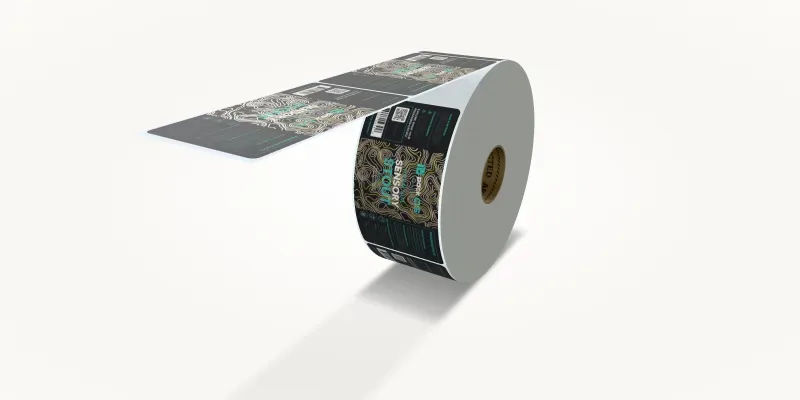
See it on the roll first
Turn your label on a 3D roll in the copy position you choose and check it before you order.
Upload artwork →Labels only. Foil, embossing and other specialty work are quoted by our team.
Describe the failure before choosing a fix
Write down what happened without embedding an assumed cause.
MORE USEFUL
- “Lower edge lifted after chilled storage”
- The affected SKU and where the label was placed
- How many units were inspected and how many showed the symptom
- When they were observed
LESS USEFUL
- “Bad adhesive”
- A description with an assumed cause built in
- A convenience sample turned into a production defect rate
| Observation | Record next | Question to investigate |
|---|---|---|
| No initial attachment or sliding | Surface condition and temperature, label lot and application method | Did the actual surface and process match the proposed construction? |
| Initial attachment followed by release | Time to failure and operations between application and inspection | What changed during conditioning, storage or handling? |
| Edges lift while the center holds | Shape, placement, container curvature and finished construction | Is the failure related to geometry, application or construction? |
| Only one lot or part of a run fails | Label and container lots, line settings and sequence | Which recorded variable differs between affected and unaffected units? |
| Failure appears after exposure | Actual product, water, temperature or handling sequence | Was that sequence included in qualification? |
Have your artwork? See the price for every quantity in seconds.
Get instant label pricing →Surface energy is one part of the investigation
Surface compatibility matters, but a resin name is not a diagnosis. Give the label supplier the actual container reference, coating or treatment and representative samples. PE or PP may call for a different construction from glass, yet “plastic” does not identify every relevant surface condition.
Avery Dennison’s application troubleshooting guidance identifies several possible contributors to edge lift or fall-off, including application pressure, temperature, surface compatibility and contamination. It directs users to technical data and supplier support. Its November 2021 South Asia guide is useful technical context, not a current packOS product specification. Avery Dennison guide, application page
Keep the face stock, adhesive, liner, print and finish connected in the construction record. A water droplet or a comparison with another container is not, by itself, qualification of that finished label. For prospective selection, use the adhesive buyer guide.
Build hypotheses from the job record
Do not rank causes without evidence from this job. Compare the actual application with the approved brief, and mark missing information as unknown. Avery’s support guidance also lists compatibility, contamination, stock age or exposure, and adhesive type as possible factors. That list supports investigation, not a universal remedy. Avery adhesion support
| Evidence area | Information to collect | Avoid assuming |
|---|---|---|
| Surface | Container item and lot, coating, cleaning process and visible moisture | A familiar resin means the surface is unchanged |
| Construction | Supplier code, label lot, artwork and finish revision | Two labels sold under the same material name are equivalent |
| Application | Measured conditions, machine or hand method and relevant settings | Room temperature equals container surface temperature |
| Time and handling | Interval before each operation, storage and exposure sequence | Every construction reaches the same bond at a fixed time |
| Geometry | Dimensions, corner shape, position, curve and overlap if present | An approval on a flat panel applies to every container |
| Stock history | Supplier storage requirements, receipt, handling and any excursions | Age or appearance alone proves a defective adhesive |
Labeling cosmetics? Start with the cosmetic label page.
Cosmetic labels →Run a controlled comparison before changing production
- Preserve the starting conditionRetain representative failed and unaffected units and unused labels with their identities. Photograph the placement and failure before peeling, cleaning or reapplying anything.
- State a specific questionFor example: does the recorded failure also occur with another retained container lot under the same documented application sequence?
- Agree the methodAsk the relevant supplier or quality owner to define samples, application, conditioning, inspection times and acceptance criteria. Use the actual finished construction and intended container.
- Change one planned variable where practicalRecord unavoidable differences. If the comparison changes the container, adhesive and temperature together, it cannot isolate which change explains the result.
- Inspect and retain the evidenceRecord attachment, edge condition, appearance and any other agreed outcomes separately. Keep photographs, sample counts and deviations with the record.
- Review before releaseDecide what the comparison supports, what remains unresolved and who approves the next action. Verify a revised specification under representative production conditions.
Do not add an unapproved solvent, primer, surface treatment or heat step to make a sample pass. Confirm compatibility and process requirements with the responsible suppliers before changing cleaning, product temperature or machine settings. More pressure is not a universal answer.
Ask for the supported conditioning interval and handling sequence for the exact construction. Initial attachment and later adhesion are different observations; avoid describing every pressure-sensitive label as needing the same “cure time.” For chilled products, separate temperature at application from later service conditions, as explained in the beverage label guide.
No file yet?
Open a sample label in PackOS
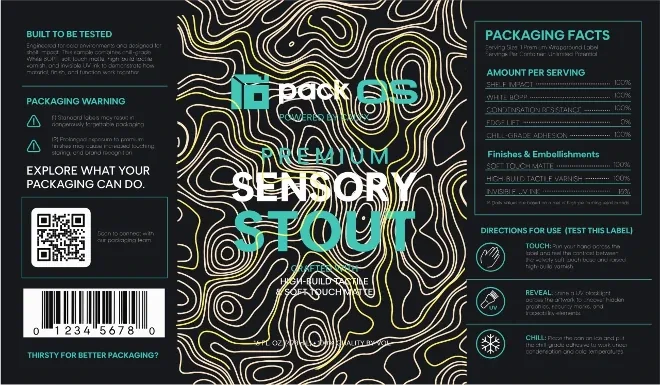
Load the Sensory Stout sample to see the price, the dieline and the label on a 3D roll before you upload your own.
Open the sample label →Worked example: one comparison, one limited conclusion
Hypothetical example, not a packOS case study: a team observes lower-edge lift on a labeled bottle after chilling. The label specification is unchanged, but two container lots were used. The team records the affected units and keeps samples from both lots.
With its supplier, it plans a comparison using the same label lot, artwork, placement and documented application and exposure sequence. The container lot is the planned difference. The record includes the agreed sample count and inspection times; this guide does not supply universal pass/fail thresholds.
| Observed result | Supported next step | Unsupported conclusion |
|---|---|---|
| Lift appears on samples from one container lot | Investigate the lot difference with the container and label suppliers | The container supplier caused the failure |
| Lift appears on samples from both lots | Review the shared construction, geometry, application and exposure conditions | All supplied labels are defective |
| No lift appears in the comparison | Check whether the comparison represented the failed production sequence | The production problem is solved |
Document the limits of the comparison. A short trial cannot establish performance for untested shelf life, lots or environments. Retain the decision and the requirements for any further trial before releasing changed production.
Once a revised label specification is supported, price it from the artwork.
Upload artwork for an instant quote →Separate technical evidence from responsibility
A passing comparison on a cleaned container does not prove that the original production process was at fault. A different roll failing does not, by itself, establish a manufacturing defect. Both results can help narrow the investigation when the variables and sample identities are known.
Photograph where separation appears and ask the supplier to help interpret it. Adhesive on the container, face or liner can be relevant evidence, but appearance alone is not enough to determine mechanism or responsibility. Keep commercial responsibility separate from the technical record until the parties have reviewed the findings.
For related symptoms, see bubbling and peeling. Avoid replacing a construction based only on the visible symptom; a proposed replacement still needs qualification for the intended job.
Send a supplier an investigation record they can use
Escalate promptly when a failure affects a released job, differs from the approved trial or needs expertise you do not have. Ask the responsible quality owner to decide containment and disposition of affected goods. Keep altered trial samples separate from the original evidence.
Send a focused packet rather than only a close-up photograph:
- Order, SKU, label construction code, artwork revision, and label and container lot references.
- Overview and close-up photographs with sample identity, position and inspection time.
- Application and later handling conditions, including what was measured and what is unknown.
- Observed count and inspected count for each identified sample group.
- Approved brief, data-sheet revision, prior trial record and any changes since approval.
- Comparisons already made, deviations, outcomes and the specific question requiring review.
Download the construction trial worksheet (CSV)
Use the worksheet instructions to retain the comparison and approval record. The blank download does not submit your completed investigation to packOS or certify a corrective action.
Instant label pricing
Upload your artwork and see the price
Drop in a PDF or AI file. PackOS reads the size, shape and colors and prices it from 10,000 labels per size.
Upload artwork →Carry the finding into the next label order
Update the approved construction and application brief with the supported corrective action, restrictions and approval owner. Connect it to the SKU and artwork revision. Make any substitution or changed production condition visible before a reorder.
For a new quote, provide artwork, dimensions and quantities, then review the available specification. Artwork alone cannot establish adhesive suitability. Keep the container, application and exposure requirements with the request, and confirm anything not represented by the quote options with the team. The custom roll-label buying checklist covers the complete enterprise request.
Frequently asked questions
Why won’t my labels stick to plastic?
Surface compatibility, condition, application and construction can all matter. Identify the actual container and label lots, record the conditions and ask the supplier whether the proposed construction supports that surface. The resin name alone does not establish a cause.
Why do label edges lift after application?
Record the label geometry, placement, container curvature, time to lift and intervening exposure. Compare those observations with the approved process. Edge lift can guide an investigation but does not identify a single cause.
How long should I wait before evaluating adhesion?
Use the supplier-agreed conditioning interval and inspection method for the exact construction and application. Record both early and later observations when relevant. There is no single waiting period that qualifies every label.
Should I clean the container with alcohol?
Do not adopt a solvent-cleaning step without confirming container compatibility and the approved process. Ask the container and label suppliers about the actual contamination and suitable preparation, then document any agreed change.
Can I apply labels to a cold or wet container?
Confirm that the exact construction supports the actual surface temperature and moisture state at application. A cold-storage rating alone does not answer that question. Test the intended application and later exposure sequence.
Does a passing control sample prove who caused the failure?
No. It helps answer the specific question tested under the recorded conditions. Check what differed from production and what remains unknown before assigning a cause or commercial responsibility.
What should I send my label supplier?
Include identified failed and unaffected samples, construction and lot references, photographs, application and exposure records, the approved brief, and results of any controlled comparison. State the specific question you need the supplier to review.
Can a new adhesive be approved from the artwork file?
No. Artwork helps specify size, graphics and print requirements. Adhesive qualification also needs the actual container, application and service brief, supplier-supported construction and representative trial evidence.