
Hot sauce label requirements: what the FDA rules actually say
Bringing a hot sauce to shelf means getting the label right the first time. The FDA has a specific, mostly plain set of rules for what has to appear on a food label, and hot sauce adds two wrinkles most first-time makers miss: sulfites and the acidified-food process filing.
THE SHORT ANSWER
Enter your container size to get the label size, then price it. Hot sauce label requirements cover five mandatory label elements: the statement of identity, net quantity, Nutrition Facts (unless an exemption applies), the ingredient list with required allergen declarations, and the responsible firm. Hot sauce adds a sulfite declaration when applicable and, separately from labeling, an acidified-food process filing for most recipes. The key pieces:
- Statement of identity: what the product is ("hot sauce," "cayenne pepper sauce")
- Net quantity: the fill in both US customary and metric units
- Ingredient list & allergens: descending order by weight, with required allergen-source disclosure
- Nutrition Facts: small-package formats (under 40 sq in of label surface) or an exemption may apply
- Sulfites & acidified-food filing: declare sulfites at threshold; file the process with FDA
Not legal or regulatory advice. This article is a plain-language overview for people bringing a hot sauce to market, not compliance guidance. US food labeling and acidified-food rules are set by the FDA and can change, and the details differ by product and by market. Confirm what applies to your recipe with the FDA and your co-packer before you print, and re-check periodically, because the rules change.
Designing the bottle first? Skip the guesswork on physical size and try the free label size calculator. It turns a woozy bottle's diameter and straight-wall height into the exact wrap width and label height, so your artwork fits the glass before you send it to print.
Find your label size
Measure the usable panel on the real container, not the capacity printed on it. Enter the diameter and the panel height. A full wrap is the circumference (π × diameter) plus a small overlap, or minus a small gap.
Wrap calculator
8.29 × 3.63 in
Circumference 8.17 in · 1/16 in clearance top and bottom
Planning math for a straight cylinder: wrap = π × diameter + overlap. Confirm with a full-size mockup on the real container.
Why start in PackOS
Once you know the details, see the price, the dieline and your label on a roll in one place.
From file to price in PackOS
What you get in PackOS
Skip the spec form
Upload a PDF or AI file and PackOS reads the size, shape, colors and finishes from your design. Nothing to retype.
Upload artwork →Instant price · sample label
| Run | Per label | Total |
|---|---|---|
| 10,000 | $0.1996 | $2,346 |
| 60,000 | $0.1692 | $10,500 |
| 110,000 | $0.1670 | $18,722 |
| 150,000 | $0.1663 | $25,290 |
| 200,000 | $0.1658 | $33,500 |
| 250,000 | $0.1655 | $41,725 |
Know the price before you ask
Every quantity is priced as soon as the file is read, with no waiting on a quote. Runs start at 10,000 labels per size with at least 2,500 per SKU. Your price depends on your artwork. Order online; the proof and a payment link follow by email.
Get instant label pricing →
Get a production dieline
No artwork yet? Draw the die with cut, bleed and safe-area lines so your designer starts from the right shape. We email it with your quote.
Create a label dieline →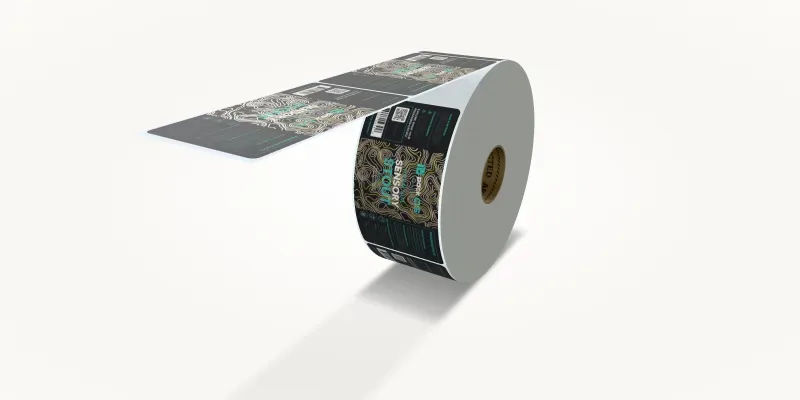
See it on the roll first
Turn your label on a 3D roll in the copy position you choose and check it before you order.
Upload artwork →Labels only. Foil, embossing and other specialty work are quoted by our team.
The five mandatory label elements
FDA requires five components on a packaged food label, and hot sauce is no exception. These are the core hot sauce label requirements every bottle has to satisfy before it sells across state lines. The FDA governs the content; your state may layer registration or cottage-food rules on top. Here are the five mandatory elements and where each one belongs.
| Element | What it must show | Panel |
|---|---|---|
| Statement of identity | The common name of the food ("hot sauce," "cayenne pepper sauce," "fermented chili sauce") in bold type on the front. | Principal display panel (PDP) |
| Net quantity of contents | The fill, shown in both US customary and metric (e.g. fluid ounces and milliliters), in the bottom 30% of the front panel. | PDP |
| Nutrition Facts | The Nutrition Facts panel, unless an exemption applies. Small packages may use a tabular or linear format (covered below). | Information panel |
| Ingredient list (with allergens) | Every ingredient in descending order by weight, using common names, with required major-allergen sources declared in the list or in a separate "Contains" statement. | Information panel |
| Name & place of business | The name and address of the manufacturer, packer, or distributor (the responsible firm). | Information panel |
The Nutrition Facts panel has its own format rules and exemptions, covered next. The FDA's Food Labeling Guide is the primary reference for all of these, and the same framework runs through our broader guide to food packaging regulations.
Food and beverage labels
Labels for bottles, cans and jars
See the stocks and adhesives we print for food and beverage brands, including Beverage White with CHILL.
See food and beverage labels →The nutrition panel: full, simplified, or exempt
A Nutrition Facts panel is required on most packaged foods, and knowing whether you need the full format, a simplified one, or an exemption is where a hot sauce nutrition label most often goes wrong. Three things decide it:
- Available label space. FDA's small-package provisions (21 CFR 101.9(j)(13)) allow tabular or linear Nutrition Facts formats when the total surface available for labeling is under 40 square inches; the separate “simplified” format under 101.9(f) is a different test, for products with insignificant amounts of seven or more nutrients. A woozy bottle is small, so a small-package format often applies. Confirm the current rules and which format applies with the FDA before you rely on it.
- Serving size. Nutrition Facts are per serving, and the FDA sets a reference amount for condiment-type sauces that is small (on the order of a teaspoon) rather than something you choose. Use the FDA reference amount, not a guess.
- Exemptions. The FDA offers a small-business exemption and a low-volume exemption from nutrition labeling, each with specific employee-count and annual-unit thresholds, and the small-business exemption requires filing an annual notice with the FDA. These change, so check your current eligibility directly with the FDA rather than assuming a number.
Even when a nutrition exemption applies, the other four elements still do, and any nutrient content claim ("low sodium," "sugar free") generally brings a full panel back. When in doubt, print the panel; it rarely sinks a label.
Acidified food: a food with a natural pH above 4.6 that has an acid (commonly vinegar or citric acid) added to bring the finished pH to 4.6 or below, which is how most hot sauces are made and preserved. See more terms in the packaging glossary.
Sulfites and allergens: two declarations hot sauce misses
Two of the hot sauce label requirements trip up first-time makers more than any others: the allergen declaration and the sulfite declaration.
Allergens. A separate "Contains" statement is not always required. FDA permits major-allergen food sources to be identified through the ingredient list or a separate "Contains" statement. If a "Contains" statement is used, include all required major-allergen sources. Review every ingredient and sub-ingredient with the responsible food-label reviewer. See FDA food-allergen labeling guidance.
If a hot sauce contains sulfites at or above the FDA's threshold (generally 10 parts per million, measured as total sulfur dioxide), the sulfites must be declared on the label. Sulfites can arrive through a preservative, dehydrated peppers, or certain vinegars, so they are not always obvious from your recipe card. If yours cross the threshold, declare them; if you are unsure, have the finished sauce tested. Verify the current threshold and required wording with the FDA.
Have your artwork? See the price for every quantity in seconds.
Get instant label pricing →The acidified-food rule most makers don't know
Here is the requirement that surprises nearly every new brand, and it is not a label line at all. Most hot sauces are acidified foods: low-acid ingredients like peppers, garlic, and onion brought to a finished pH of 4.6 or below with vinegar or another acid. Acidified foods are regulated under 21 CFR Part 114, and processors of them generally must do three things:
- RegisterRegister with the FDA.
- File a scheduled processOne for each product.
- Train a supervisorOperate under a supervisor trained through a recognized process-control course.
In plain terms: before you can legally sell most hot sauces, someone has to establish and file a safe process that reliably hits the target pH. A nice label is not enough. A qualified co-packer handles this as a matter of course; if you self-produce, treat the process filing as a hard prerequisite and work it out with the FDA and a process authority. State agencies may add requirements on top.
Hot sauce bottle label size (the woozy bottle)
Unlike the content rules, there is no legal hot sauce bottle label size. The physical dimensions are set by your bottle, not by the FDA. The classic vessel is the woozy: the tall, narrow, ringed glass bottle with a small orifice reducer that meters out a few drops at a time. Because it is round, sizing a label is a geometry problem, not a lookup: the wrap width equals the bottle's circumference (π × diameter) minus a small gap so the ends butt together (or plus a small overlap if the label is meant to overlap), and the height is the straight wall minus a little clearance top and bottom.
The woozy bottle label dimensions below are typical and approximate. They vary by glass supplier, so measure your actual bottle before you commit artwork.
| Bottle | Typical fill | Typical body diameter | Approx. wrap width (π × diameter) |
|---|---|---|---|
| 5 oz woozy | ~5 fl oz | ~1.8 in | ~5.7 in (less seam gap) |
| 10 oz woozy | ~10 fl oz | ~2.2 in | ~6.9 in (less seam gap) |
| Front-only label | Any | n/a | Fits the flat labeling band; commonly ~2 in wide |
These are common values, not a standard. Rather than eyeball it, plug your bottle's real diameter and straight wall into our free label size calculator and it returns the exact wrap width and height, including the seam overlap. It is the same math, done for you. For the full method and sizes across other containers, see label sizes by container.
One more physical rule: the FDA sets minimum type sizes for mandatory copy: most information-panel text is generally required to be at least about 1/16 inch tall, and net-quantity type scales with the front panel. Small woozy labels leave little room, so lay the required copy out first. Confirm the current minimums with the FDA.
Measured your woozy bottle? Take the wrap width and height straight into a label dieline.
Create a label dieline →PDP vs information panel: where each element goes
Knowing what to put on a hot sauce label is only half the job; the FDA also cares where it goes. Two zones matter:
PRINCIPAL DISPLAY PANEL (PDP)
- The part of the label a shopper sees first on shelf
- Carries the statement of identity and the net quantity of contents
- On a round bottle, roughly the front 40% of the circumference
INFORMATION PANEL
- Generally the panel immediately to the right of the PDP as the bottle faces you
- Carries the ingredient list, any separate allergen "Contains" statement, the Nutrition Facts, and the name and address of the responsible firm
- These must run together without unrelated design or copy intervening
On a full-wrap woozy label, plan the layout as one continuous strip: identity and net quantity in the front field, then the information block flowing into the back, with the seam in a quiet spot. Get the zoning right the first time. The same principal-display-panel logic governs adjacent categories, so see our cosmetic label requirements and supplement label requirements guides, which share the FDA's panel framework with their own twists.
Instant label pricing
Upload your artwork and see the price
Drop in a PDF or AI file. PackOS reads the size, shape and colors and prices it from 10,000 labels per size.
Upload artwork →How PackOS helps you lay it out
Meeting the hot sauce label requirements is a content-and-process job; getting the printed label physically right is a manufacturing job. Upload your label artwork to Quick Quote, review the detected attributes and confirm the selected specification. Compare the available quantities and read the quote's assumptions, tooling and delivery terms. This guide is part of our complete guide to food & beverage packaging; if you are building a food or beverage line, our food & beverage industry page shows how the whole flow fits together.
Just remember the split: Quick Quote covers the printed roll label, but the FDA content rules and the acidified-food process filing are yours to confirm with the authority and your co-packer.
Frequently asked questions
What are the mandatory elements on a hot sauce label?
FDA requires five components on a food label: a statement of identity (what the product is), the net quantity of contents in both US customary and metric units, a Nutrition Facts panel unless an exemption applies, an ingredient list in descending order by weight that declares applicable major food allergens, and the name and address of the manufacturer, packer, or distributor. Confirm the current rules with the FDA before you print.
Do I need a Nutrition Facts panel on my hot sauce?
Most packaged hot sauces need a Nutrition Facts panel. The FDA allows small-package formats (tabular or linear) when the total surface available for labeling is under 40 square inches, and there are separate small-business and low-volume exemptions with specific employee-count and annual-unit thresholds. Check whether your product qualifies directly with the FDA rather than assuming, because the criteria change.
Do hot sauces need a sulfite declaration?
If a hot sauce contains sulfites at or above the FDA threshold, generally 10 parts per million measured as total sulfur dioxide, the sulfites must be declared on the label. Many recipes contain no sulfites, but a preservative, dehydrated peppers, or certain vinegars can introduce them. If yours cross the threshold, declare them, and verify the current threshold and wording with the FDA.
What size label fits a standard woozy hot sauce bottle?
There is no legal label-size standard; the size is set by your bottle. A common 5 oz woozy bottle has a body diameter of roughly 1.8 inches, so a full-wrap label is about 5.7 inches wide, which is pi times the diameter, minus a small seam gap if the ends butt. Measure your actual bottle and compute the exact wrap with the label size calculator.
Is hot sauce an acidified food that needs FDA registration?
Most hot sauces are acidified foods, made by adding vinegar or another acid to low-acid ingredients like peppers and garlic to reach a finished pH of 4.6 or below. Acidified-food processors generally must register with the FDA, file a scheduled process, and operate under a trained supervisor. This is a processing requirement separate from labeling. Confirm what applies to your recipe with the FDA and your co-packer.